
How to Control an AI Story's Tone (With Real Examples)
If you want to control an AI story's tone, the lever is the prompt, not the tool. Type a scene with no direction and you get a safe, generic literary voice every time. Add two or three words that name the tone you want — cold and clinical, or lush and gothic — and the same model rewrites the same events in a completely different register. This is a short, practical guide to steering AI writing tone, with real outputs you can read and copy.
Every example below was generated on aiWriter.ai with Deep Writer v2. Nothing is paraphrased or cleaned up — the point of showing the text (instead of a screenshot) is that you can select it, copy the prompt, and reproduce it.
The short version: tone lives in the prompt
Tone is a prompt problem, not a model problem. The model already knows how to write cold, wry, tender, or menacing prose — it just doesn't know which one you want unless you say so. With no instruction, it defaults to the middle of the road. So the single most effective thing you can do is name the voice: the emotional register, the sentence rhythm, and the sensory palette.
Here's the same scene with no tone direction at all — just the situation:
A woman returns to her childhood home the day after her mother's funeral and finds the locks have been changed.
She twisted the key, but the deadbolt refused to budge. "That's impossible," Lena muttered, jiggling the worn brass handle. Her mother had never changed the locks in forty years.
She stepped back onto the peeling porch paint, the July sun hot on her neck. Through the front window's lace curtain, she could see the empty armchair, the television dark. Her own reflection looked back, a stranger in a black dress. She tried her key again, pressing her shoulder against the solid oak door. It held fast.
The spare key wasn't under the flowerpot. She walked around to the back door, her heels sinking into the soft lawn. That lock was new too, a shiny silver cylinder. On the kitchen table, she could see the familiar red-checked cloth, a single white envelope placed squarely in the center.
She picked up a loose patio brick and, after a moment's hesitation, brought it down on the door handle. The glass cracked in a spiderweb, and with a push, she reached through and turned the knob from the inside.
She went straight to the envelope, her name written in her mother's looping script. Inside was a new silver key and a note. "The old locks never kept anything out, or in. Try this one. Love, Mom."
Lena fitted the key into the front door. It turned with a smooth, quiet click. She stepped inside, closed the door behind her, and finally allowed herself to cry.
Watch the lever move: one scene, two tones
Now keep the scene identical and add one line of tone direction. Nothing else changes — same model, same setup, same length. Watch what happens to the prose.
First, ask for cold and clinical:
A woman returns to her childhood home the day after her mother's funeral and finds the locks have been changed.
Tone: cold, clinical, emotionally restrained. Short declarative sentences. No sentimentality, no metaphor.
The key didn't turn. She tried again, applying pressure until the metal felt ready to snap. It simply stuck.
She stepped back onto the frost-stiffened lawn and looked at the front door. A new deadbolt gleamed above the old brass handle. She pulled her coat tighter.
Her brother's car was gone from the driveway. She hadn't seen him at the funeral reception either. She walked to the side gate, its latch frozen shut. She yanked it hard and the bolt tore free with a splintering crack.
The back door had the same new lock. She peered through the kitchen window. Everything was clean. The counters were bare. The yellow cookie jar was gone.
A movement inside caught her eye. A real estate agent's sign was leaning against the hall table, ready for the lawn. She saw the stacked boxes in the living room.
Her phone buzzed. A text from her brother. 'The estate sale is next Saturday. I've taken the piano. Lawyers will send the paperwork.'
She didn't reply. She turned and walked back to her car. The cold air felt thin and sharp. She started the engine and drove away without looking in the rearview mirror. The house became just another shape on the street, then it was gone.
Now the same scene again, steered the opposite way — lush Southern Gothic:
A woman returns to her childhood home the day after her mother's funeral and finds the locks have been changed.
Tone: lush Southern Gothic. Long, sinuous sentences. Oppressive heat, decay, and dread soaked into every image.
The key wouldn't turn. Lena jiggled the tarnished brass in the deadbolt of the weathered front door, the metal hot from a morning already thick as spoiled honey. She'd come straight from the graveside, her black dress sticking to the small of her back. Behind her, the live oak's Spanish moss hung motionless in the breathless air.
"Open up, you old thing," she whispered, but the lock held fast. A fresh, sharp scratch marred the plate around it. She stepped back onto the creaking porch, the gray boards groaning under her weight, and peered through the grimy parlor window. Everything was as it was, yet utterly changed: the velvet settee, the dusty crystal decanters, her mother's embroidered shawl draped over the chair back as if she'd just risen.
The back door was also newly locked. Lena circled the house, her heels sinking into the soft, black earth of the overgrown garden. The keyhole there was packed with fresh, red clay. At the cellar doors, slanted against the foundation, a single, long strand of her mother's silver hair was caught in the hasp. Lena knelt, the damp seeping through her skirt, and worked the rusty latch with trembling fingers. The right door swung open with a sigh, revealing the cool, dark throat of the cellar stairs. From the darkness below, a familiar voice, papery and thin, curled up like smoke. "Took you long enough, sugar. I got tired of waiting."
Three outputs, one prompt — separated by a single tone line. The setup is identical each time (a woman, a funeral, a changed lock), but everything downstream shifts: the sentence length, the imagery, the mood, even where the story chooses to go. That’s the point — one line of direction doesn’t just repaint the prose, it changes what the model reaches for. That’s tone steering doing real work, not a cosmetic filter.
What actually moved the tone
The steering instructions worked because they named how the prose should sound, not just the mood. "Sad" is vague; a model can render it a hundred ways. These three levers do the real work:
- Register — the emotional stance: cold, tender, wry, reverent, detached. This sets what the narrator feels about the scene.
- Sentence rhythm — "short declarative sentences" versus "long, sinuous sentences" physically reshapes the prose on the page. This is the single highest-leverage instruction most writers forget to give.
- Sensory palette — "decay, oppressive heat" versus "clean, clinical" tells the model which details to reach for. Tone is carried as much by what gets described as by how.
A tight three-word label ("cold, clinical, restrained") moves the prose further than a long, hedge-everything paragraph. Be specific and be brief. For more on writing prompts that land, see our guide to AI story prompts.
Steer at paragraph scale, not just the opening
A tone line at the top sets the whole piece. But you can also steer one beat at a time — which matters when you want the register to shift mid-story (calm to dread, say) instead of locking one voice for the whole draft. Here the instruction is paragraph-scale: same idea, but the second one is told to hold back.
One idea, base vs. steered — side by side:
The moment a detective realizes the suspect in the photo is her own brother.
The photograph was supposed to be just another piece of evidence, another face in the gallery of her failure, but as Lena's thumb brushed the smudged corner of the print, the coffee in her other hand went cold; the scar above the left eyebrow, the one she'd stitched herself when they were kids, was unmistakable, and the case file she'd been building for months collapsed into a single, horrifying truth.
The moment a detective realizes the suspect in the photo is her own brother. Make it understated and devastating — no melodrama, no exclamation; let the restraint carry the blow.
The photograph was glossy under the fluorescent lights of the squad room, the graininess doing little to obscure the familiar set of the shoulders, the particular angle of the head she'd seen across a thousand family dinners, and there in the grainy black-and-white, caught by a traffic camera leaving the scene, was the impossible contour of her brother's jaw.
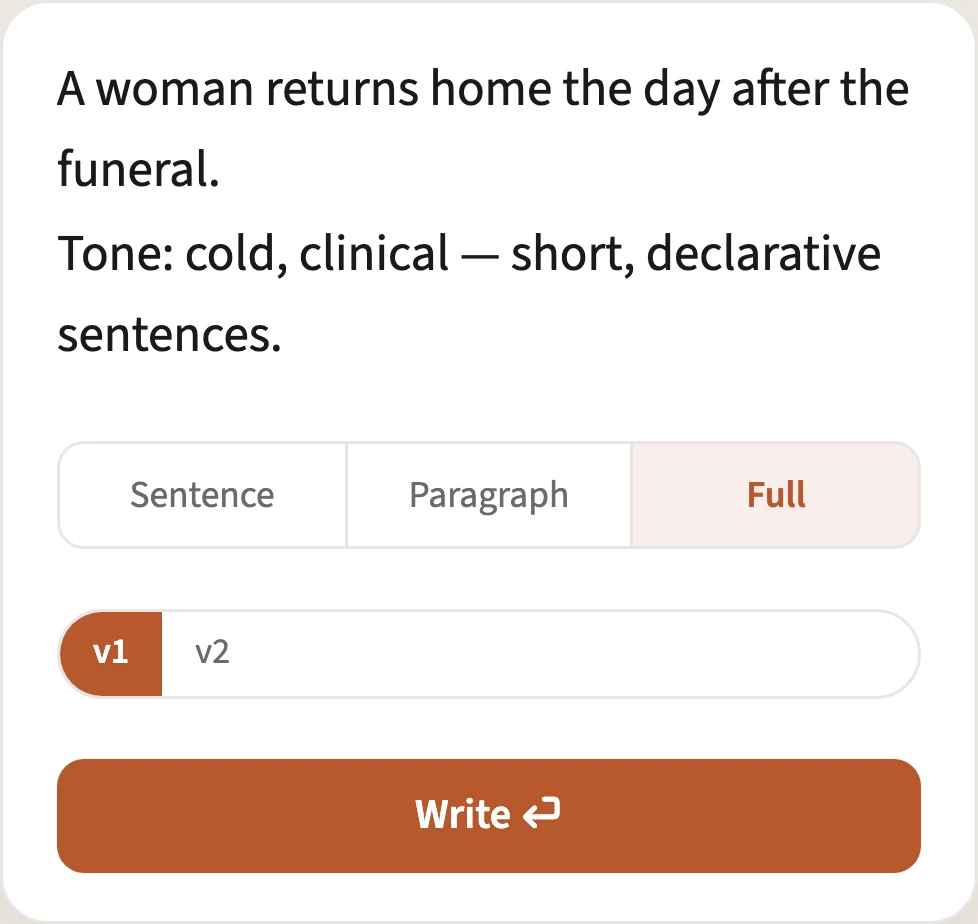
On aiWriter's writing canvas you don't have to retype the whole scene to do this. Generate a paragraph, then add a one-line direction and continue — the steer applies to the next beat. The scope buttons let you generate a sentence, a paragraph, or a full piece at a time, so you can adjust tone as the draft grows.
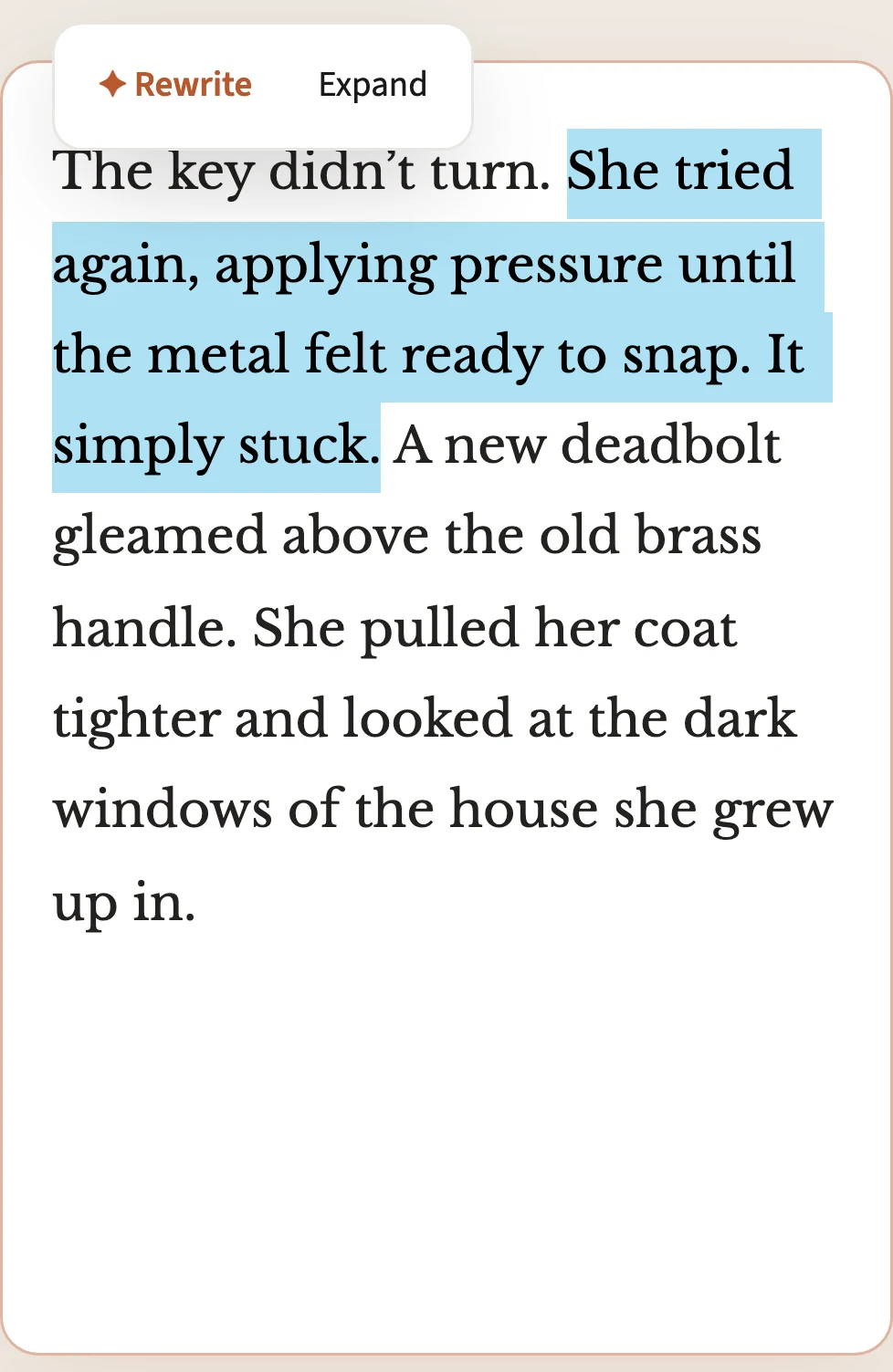
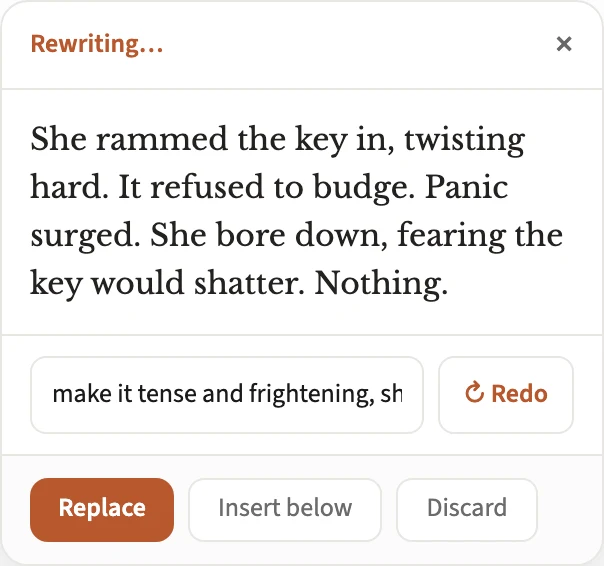
You can also revise prose you've already generated. Select a passage and a small toolbar lets you Rewrite or Expand just that passage, without touching the rest of the draft. With no instruction, Rewrite tightens the flow and word choice while keeping the meaning and voice intact — but after the first pass you can hand it a tone nudge (“make it tenser,” “colder,” “add more sensory detail”) and Redo until it lands.
Where general-purpose assistants get in the way
Tone control is a prompt skill that works in any capable model — the technique above isn't specific to aiWriter. The difference shows up at the edges of register. General-purpose chat assistants are tuned to soften or decline darker territory, so a tone instruction like "make this crueler," "lean into the dread," or "don't redeem this character" often gets a hedged, warmed-over result rather than the register you asked for. That's a product decision on their side, not a limitation of the prompt.
aiWriter is a free AI story generator built for fiction, and it doesn't refuse dark, explicit, or morally complex registers — the tone you ask for is the tone you get. If your draft needs to go somewhere a general assistant tends to back away from, the unfiltered mode keeps the exact same tone controls without softening the content. (Behaviour of any given assistant changes over time; the durable point is simply that aiWriter is tuned to honour the register you specify.)
A repeatable method for steering tone
Put it together and tone control becomes a checklist, not a guessing game:
- Write the scene plainly first — just the situation and the people. Don't bury the tone request inside the plot.
- Add a single tone line naming register + sentence rhythm + sensory palette. Three specifics beat one vague adjective.
- Generate, then compare against your intent. Too warm? Tighten the register word. Too flat? Loosen the rhythm instruction.
- Steer the next beat, not the whole draft, when you only want to nudge. Continue with a one-line direction, or select a passage and rewrite it.
The model isn't the bottleneck on tone — your instruction is. Once you start naming the voice you want, the same generator that gave you generic prose will give you cold, gothic, wry, or tender on demand. The fastest way to feel it is to run one scene twice. Open the writing canvas, paste a scene, and change only the tone line.
— Art
Founder, aiWriter.ai
Frequently Asked Questions
How do I control the tone of an AI-generated story?
State the tone explicitly in your prompt — name the register (cold, lush, wry), the sentence rhythm (short and declarative, or long and sinuous), and the sensory palette. On aiWriter.ai you add a line like “Tone: cold, clinical, no sentimentality” under your scene, and the model rewrites the same events in that voice.
Why does my AI story always come out in the same generic voice?
Because you didn’t tell it otherwise. With no tone direction, a model defaults to a safe, middle-of-the-road literary register. The fix isn’t a different tool — it’s adding two or three words that name the voice you actually want.
Is there a free AI writer that lets me control tone and write dark fiction?
Yes. aiWriter.ai is a free AI story generator that takes tone direction in the prompt and doesn’t refuse dark, explicit, or morally complex fiction. The unfiltered mode keeps the same tone controls without softening the content.
What’s the difference between steering tone at the start versus paragraph by paragraph?
A tone line at the start sets the whole piece. Steering at paragraph scale — re-stating the tone, or adding a one-line direction when you continue — lets you shift register mid-story (calm to dread, say) instead of locking one voice for the whole draft.