
aiWriter.ai Summer 2026 Release: AI Novel Writing Goes Live
aiWriter.ai today announced its Summer 2026 release — the largest expansion of the platform since launch, and the point at which it stops being a story generator and becomes a place you write a book.
Over the past five weeks the platform shipped a complete long-form novel workspace, a re-architected generation path that cut median response time by roughly two thirds, professional manuscript export in three formats, a published tier-by-tier feature matrix, a public service-status page, and a partner program. What follows is the full record, organised by product area.
Novel writing, generally available
The headline of this release is the novel workspace: an end-to-end pipeline that takes a one-paragraph premise and produces a finished, exportable manuscript.
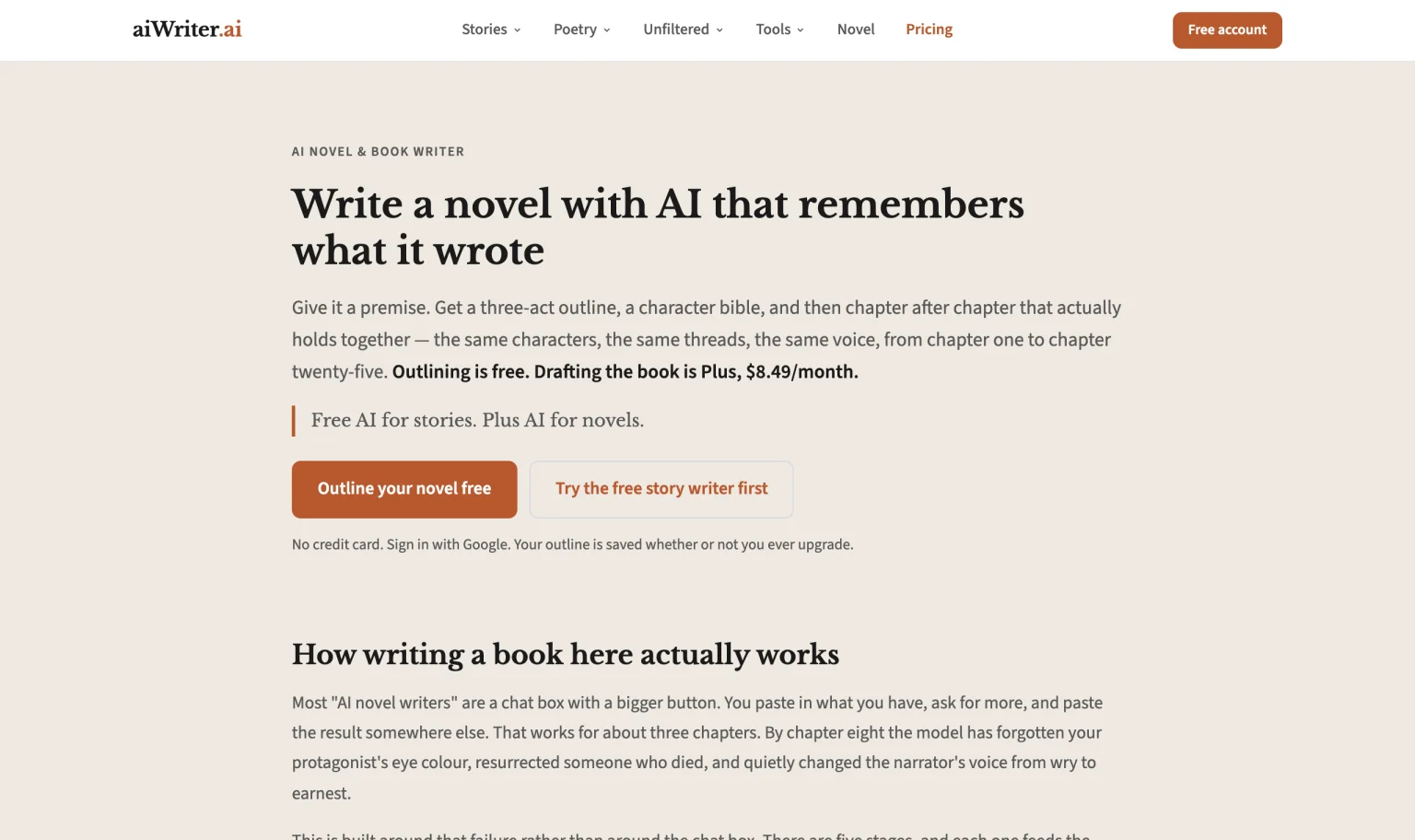
It runs in five stages, each feeding the next:
- Your premise. A paragraph, a genre, a target length, and any setting notes you want honoured.
- A three-act outline. Every chapter titled and summarised, with the act structure made explicit rather than implied.
- A character bible. The cast, their traits and their arcs, held as structured records rather than as something the model has to remember.
- Chapter drafting. One chapter at a time, sequentially, each written against a running record of what the previous chapters actually said — not against the plan for them.
- Export. The finished manuscript, in a format a publisher or an e-reader accepts.
Stage four is the one that matters, and it is the reason this exists. Most tools marketed as AI novel writers are a chat box with a larger button: you paste in what you have, ask for more, and paste the result somewhere else. That holds for about three chapters. By chapter eight the model has quietly changed a protagonist’s eye colour, resurrected someone who died, and drifted the narrator from wry to earnest. aiWriter.ai is built around that failure rather than around the chat box.
Continuity, validated before release
The drafting chain separates two things that most implementations conflate: the plan for a chapter and the summary of what was written. The plan is never overwritten, so a redraft still has the outline to steer by; the summary of the drafted prose is what feeds continuity forward. Prior to release the pipeline was run end to end on a deliberately hostile genre-fusion premise and reviewed against a three-point continuity rubric across 25 chapters and 52,470 words. It passed on all three checks, and that review — not a date — was the release gate.
Direction notes, redraft, and streamed prose
Three capabilities shipped alongside drafting, all of them answers to the same complaint: writers want control, and a button that only says go does not give them any.
- Per-chapter direction notes. Each chapter takes a free-text note that is placed last in the instruction and explicitly declared to override the outline. It is honoured on redraft as well, and pre-filled from what you said last time, so a second attempt starts from your direction rather than from scratch.
- Redraft. The most recently drafted chapter can be rewritten in place. It is deliberately restricted to the last chapter: every chapter after it was written against its prose, so redrafting an earlier one would silently invalidate everything downstream while the continuity chain still looked intact.
- Streamed prose. Chapters now render into the page as they are written rather than sitting behind a progress counter for a minute or more.
Progress you can see, and an ending that reads like one
The workspace shows a segmented progress bar whose three sections are the three acts, sized by how many chapters each holds and filled as they are drafted, over a live count of chapters and words. Completing an act leaves a quiet line in the manuscript at the boundary. Reaching the final chapter produces a genuine completion state — chapters, words, and how many days the book took — with export as the reward.
There are no points, badges, streaks or levels anywhere in this. That is a deliberate product position: mechanics that reward volume measurably damage the thing they are supposed to help. Progress here tracks the manuscript, and the success metric is chapters drafted and books finished — never sessions.
Project management
Novels can be archived (a soft state — still listed, still openable, and on Plus it frees the concurrent slot) or deleted outright, which removes the chapters and the character bible with the project. Active novels and their chapter progress now also appear in the canvas sidebar, so a half-drafted manuscript has a permanent pointer from the surface you actually write on.
Manuscript export: Markdown, EPUB 3 and DOCX
A manuscript you cannot get out of the tool is not really yours. Export ships in three formats, generated with no third-party dependencies and no binary toolchain:
- EPUB 3 — spec-conformant, and the format Kindle ingests directly via both Send-to-Kindle and KDP, as well as Apple Books and Kobo.
- DOCX — the KDP print pipeline, and every human editor you will ever hire.
- Markdown — plain, portable, diff-able.
The download bar appears as soon as one chapter is drafted, not at completion. Every archive produced during development was verified with independent tools rather than eyeballed — a corrupt manuscript being considerably worse than no export at all.
Short-form documents on the writing canvas gained EPUB export in the same release, joining plain text, Word and PDF.
Deep Writer v2: 2.4–3.4× faster
Deep Writer v2, the advanced model, was moved onto a re-architected inference path. In a length-controlled internal benchmark (n = 98), total end-to-end generation time improved by 2.4–3.4×; median total time fell from 117 seconds to 32.
Several pieces of engineering sit underneath that number, and they are the part worth stating plainly:
- Automatic failover. Any failure on the primary path falls back transparently, so an upstream outage degrades speed rather than breaking paid generation.
- Per-generation latency telemetry. Time-to-first-token and total time are recorded for every generation, attributed by model and path. Performance regressions are now measured, not guessed at.
- A stall watchdog and a Stop button. A hung stream can no longer jam the writing surface, and you can end a generation you have already decided against.
- An honest waiting state. The canvas now shows an animated working indicator where the prose will appear, cycling through what the writer is doing, cleared the instant the first token lands.
The canvas became a workspace
The short-form writing surface received the most individually small and collectively significant set of changes in the release.
- Automatic first-document save. Signed-in writers now leave their first session with a saved draft without having to think about it — including when a connection drops mid-generation, which now keeps the words rather than discarding them. Writers who leave with a saved artifact return substantially more often, and the overwhelming majority who left with nothing did so for a purely mechanical reason: nothing had created the document.
- An expanded workspace sidebar, open by default, listing your documents and your novels-in-progress with chapter counts, each with a hover-revealed delete.
- A chromeless signed-in canvas. Above 640px the site header steps aside and the left rail absorbs its work — brand, a generators drawer covering stories, poetry, lyrics, unfiltered, novels and tools, and the account menu. The writing surface gets the top of the screen back.
- Remembered length preference, so the size you picked is the size you get on the next piece.
- A “Continue your story” resume strip on the signed-in landing surface, and automatic AI-generated document titles instead of “Untitled”.
Co-writing intelligence
Two features shipped under an internal program aimed squarely at the difference between a generator and a collaborator.
Contextual next-beat suggestions. One-tap direction chips appear under the composer, generated from the tail of your story rather than from a genre template — specificity lives at the end of a passage, and a generic list would be a genre picker, not a co-writer. They are an offer, never a gate: ignore them and the composer works exactly as before.
Reactions that teach. A thumbs-up or thumbs-down on a beat is cheap and satisfying on its own, but the point is what it accrues into. Every few reactions, the platform distils them into a short per-account craft profile that later generations honour. Three design commitments govern it:
- Craft, not content. The profile describes pacing, dialogue density, register and explicitness — things that generalise. Learning your topics would give a writer who does both horror and romance a muddled profile that makes both worse.
- Explicit steering always wins. The profile is positioned below your direct instruction in the prompt hierarchy. A profile that fought your explicit steer would recreate the single most common complaint about AI writing tools.
- Visible and reversible. The profile is shown to you in plain language, with a one-click way to forget it. An invisible model of your taste is neither satisfying nor correctable.
Plans: Gold goes unlimited, and every difference is published
Gold’s monthly Deep Writer v2 allowance is now unlimited. Plus remains 5,000 per month and free accounts 10, preserving a visible ladder rather than flattening two paid tiers into the same promise.
The pricing page now carries a complete feature comparison table, generated from the same source of truth that enforces the limits in production — so the published matrix and the running code cannot drift apart.
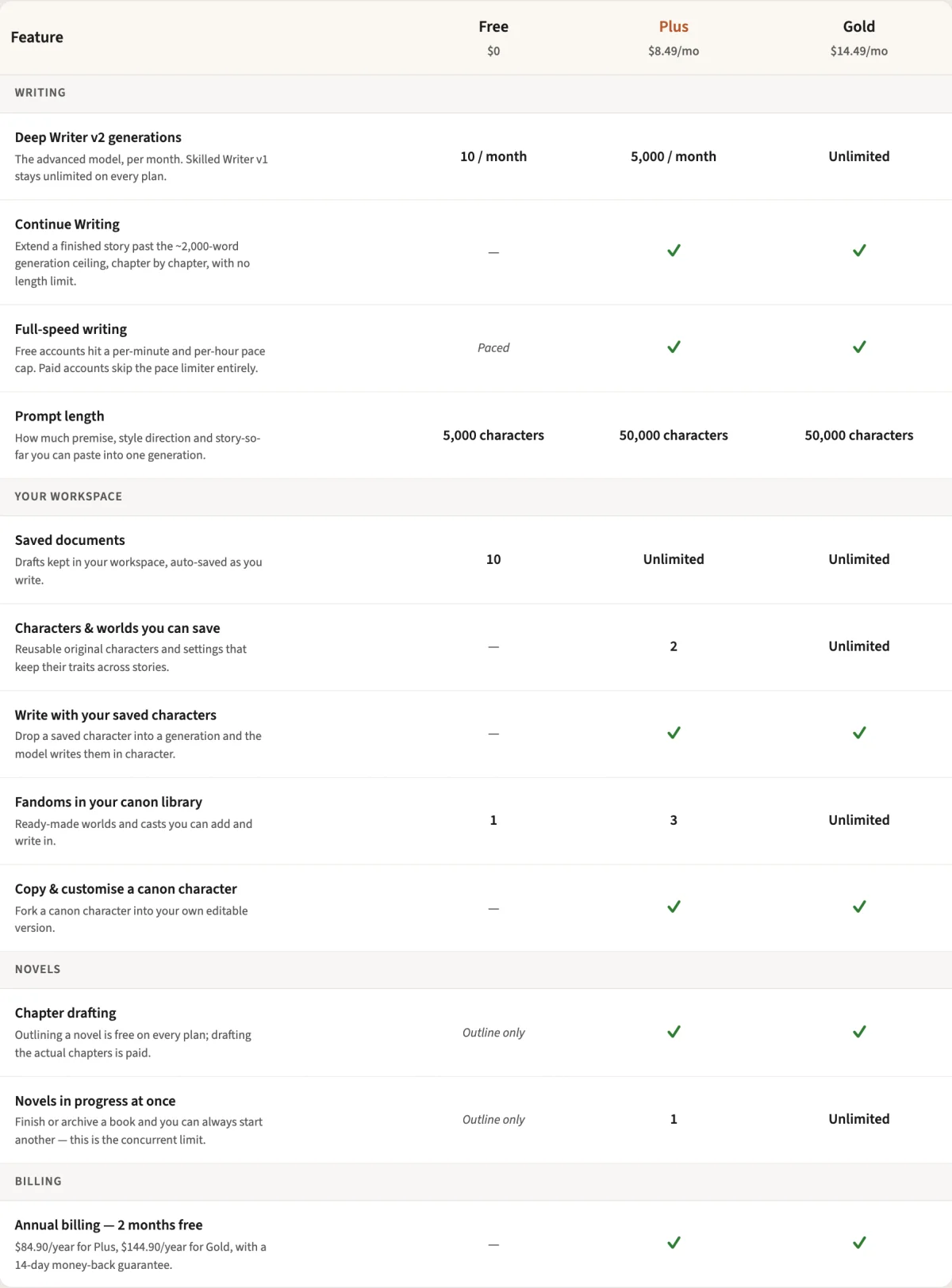
Two editorial rules govern that table, and both are deliberate. Rows only exist where the tiers actually differ — uncensored content, unlimited Skilled Writer v1, 70+ generators, novel outlining, exports and Google sign-in are identical on every plan and are stated as prose beneath it. And no row claims a difference the code does not enforce: two plausible marketing claims were removed during the build precisely because nothing in the codebase implemented them. It is a familiar failure mode in this category, and one worth naming. We have written before about why this platform prices in words and generations rather than in tokens or credits; a comparison grid that overstates itself is the same problem wearing a different hat.
Annual billing is live at $84.90/year for Plus and $144.90/year for Gold — two months free — with a 14-day money-back guarantee.
Platform, trust and transparency
Less visible than a novel workspace, and arguably more important to anyone keeping a manuscript here.
- Cryptographically signed sessions. Session cookies are now HMAC-signed, and account privileges are resolved server-side from the database on every request rather than trusted from the cookie payload. A signature proves a cookie came from us; it does not make its contents an authority on what an account is allowed to do.
- Complete account deletion. An audit found three tables missing from the deletion path, plus a residual copy of the email address. Both are fixed. When an account is deleted, it is deleted.
- Billing recovery in-product. A failing renewal now surfaces as a banner in the app, where it can actually be fixed, instead of relying solely on email. Cancelled subscriptions are no longer pursued by dunning.
- A public status page. status is now an incident-driven service board covering the web app, both writing models, sign-in and billing, with 90-day incident history and a documented lifecycle timeline for each incident.
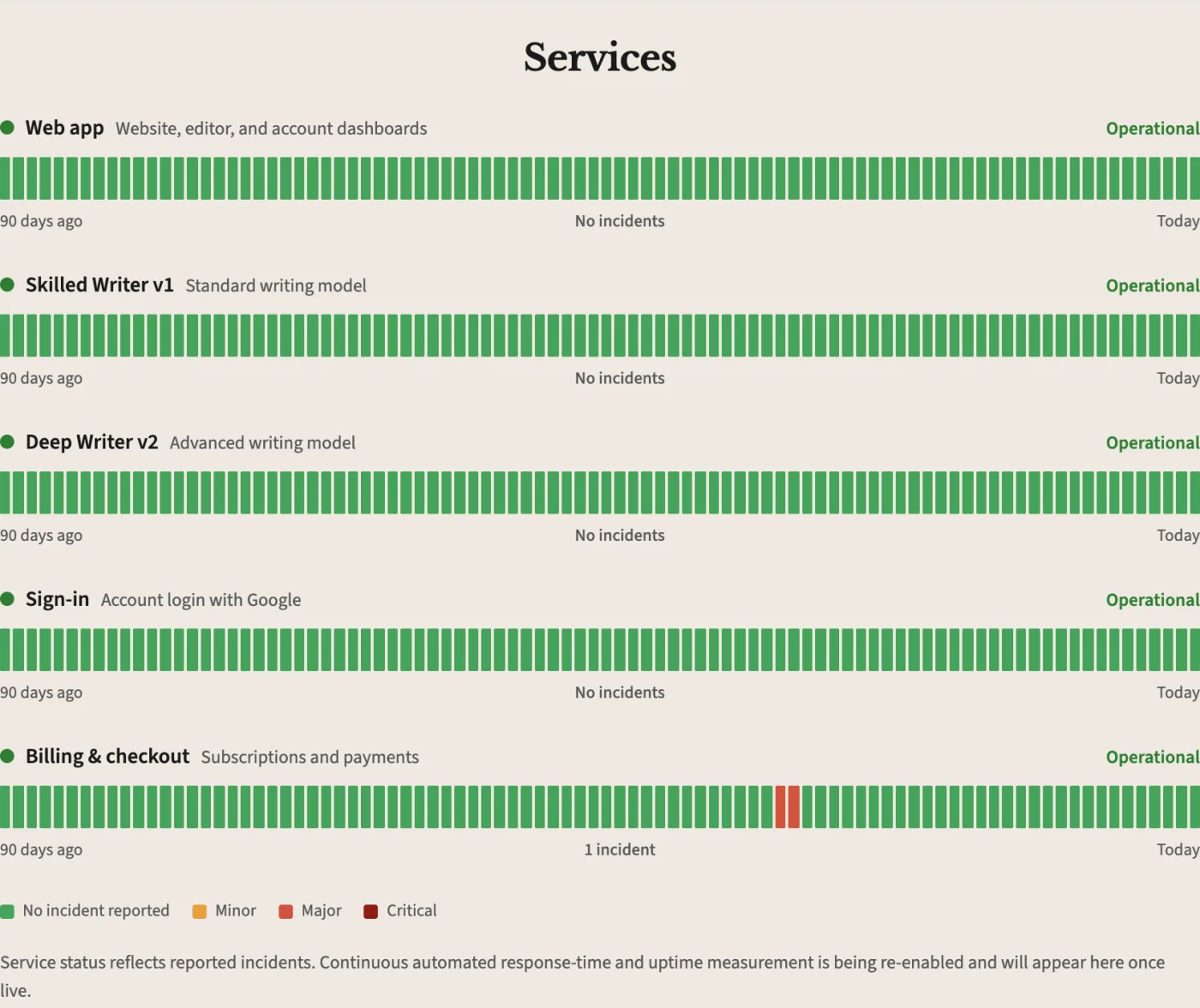
That last caption is not modesty. The page shows incident history because incident history is what we can currently substantiate; a green uptime percentage nobody is measuring would be decoration.
Content policy
aiWriter.ai remains an uncensored writing tool with exactly one refusal category: sexual content involving minors. This release hardened that boundary considerably — it is now enforced on generated output as well as input on the novel surface, in overlapping windows across a full-length chapter, so a blocked chapter is never stored and can never re-enter a later chapter as continuity context. Several false-positive classes were also closed in the same period, including one that had been refusing legitimate character sheets that simply stated a character’s age. The policy is a bright line, not a general content filter, and keeping it narrow takes as much work as keeping it firm.
Partner program
A self-hosted affiliate program is live: 50% recurring commission for up to 12 months per referred customer, Net-60 payouts by Wise or PayPal, $50 minimum. It runs on first-party attribution with a passwordless magic-link partner portal and a commission ledger, rather than on a third-party tracking script.
Availability
Everything above is live now. Novel outlining, unlimited Skilled Writer v1 generations, and the full library of 70+ free generators are available on free accounts with no credit card. Chapter drafting, manuscript export, Continue Writing, saved characters and full-speed generation are included with Plus at $8.49/month and Gold at $14.49/month.
Start a novel free at aiWriter.ai/novel, or open the writing canvas without signing up at all.
About aiWriter.ai
aiWriter.ai is an AI writing platform for fiction — short stories, poetry, lyrics, fanfiction and full-length novels — built on the position that a tool for writers should write what the writer asked for. It offers two writing models, a document workspace, a reusable character and canon library, a long-form novel pipeline, and 70+ specialised generators, with a free tier that is genuinely usable rather than a trial. It is independently operated and funded entirely by its subscribers.
— Art
Founder, aiWriter.ai
Frequently Asked Questions
Can aiWriter.ai write a full novel, or just short stories?
A full novel. The novel workspace takes a premise, produces a three-act outline and a character bible, then drafts chapters one at a time — each written against a running record of what the previous chapters actually said, so characters, threads and voice hold across the book. It was validated on a 25-chapter, 52,470-word manuscript before release.
Is AI novel writing free on aiWriter.ai?
Outlining is free on every plan, including free accounts: you get the three-act structure and every chapter title, and it is saved to your account whether or not you ever upgrade. Drafting the actual chapter prose requires Plus ($8.49/month) or Gold ($14.49/month). Plus runs one novel at a time; Gold runs unlimited concurrent novels.
What file formats can I export my manuscript to?
Markdown, EPUB 3 and DOCX. EPUB covers Kindle (both Send-to-Kindle and KDP ingest it directly), Apple Books and Kobo; DOCX covers the KDP print pipeline and any human editor. The download bar appears as soon as one chapter is drafted — a half-written manuscript is still your work.
Can I control the direction of each chapter, or does the AI just decide?
Every chapter takes a direction note that overrides the outline for that chapter, and the note is honoured on redraft too. If a chapter lands wrong you can redraft the most recent one in place. On the short-form canvas, one-tap next-beat suggestions are generated from the tail of your own story, and thumbs-up/down reactions accrue into a per-account craft profile that later generations honour.
What content does aiWriter.ai refuse to write?
One category: sexual content involving minors. It is enforced on both input and generated output, and on the novel surface a blocked chapter is never stored, so it cannot re-enter a later chapter as continuity context. Everything else — dark, explicit, morally grey, unfiltered — is written without softening or a lecture.