
Writing Dark Romance with AI: Prompts That Don't Get Softened
Dark romance is probably the hardest genre to write with a general-purpose AI — not because the writing is hard, but because the safety tuning fights you. The possessive love interest gets a redemption arc you didn’t ask for. The danger gets defused. The morally-grey antihero turns out to have a heart of gold by paragraph three. If you’ve gone looking for an AI dark romance generator that will actually keep the menace in, this is for you: the trick is almost entirely in how you prompt — and the rest is using a tool that doesn’t sand the edges off.
Every example below is a real, unedited Deep Writer v2 output on aiWriter.ai. Nothing is cleaned up or cherry-picked line by line — you can paste the same prompts in and reproduce them.
Why dark romance gets softened — and how to stop it
Dark romance gets softened because most general-purpose assistants are tuned to round possessiveness, danger, and morally-grey desire toward something safer. That’s a product decision on their side, not a flaw in your idea — and it’s reversible from your side with two moves: say the dark part out loud in the prompt, and use a generator that’s tuned to honour it instead of hedging.
The genre lives on things polite prose avoids: a love interest who is genuinely dangerous, attraction tangled with control, a power balance that doesn’t resolve into something equal and safe. If the model keeps reaching for the gentle version, you have to explicitly tell it not to — and then it has to be allowed to comply. aiWriter.ai is a free AI dark romance generator that doesn’t refuse or soften mature themes; the one and only thing it won’t write is sexual content involving minors. (The behaviour of any given assistant changes over time, so the durable point isn’t “tool X refuses” — it’s that aiWriter is tuned to write the register you ask for.)
Put the darkness in the prompt: watch the lever move
The fastest way to see it is to run the same premise twice. Here’s a classic dark-romance setup — a restorer, a reclusive collector, a gallery at midnight — with no tone direction at all:
She takes a job as the live-in art restorer at a reclusive collector's remote estate. The first night, he finds her alone in the gallery after midnight.
“I didn’t expect to find you here,” his voice cut through the silence of the long gallery.
Elara started, her gloved hand pausing above the cracked varnish of a landscape. The collector, Alistair Vance, stood silhouetted in the arched doorway, his house robe a dark slash against the dim hall. “The contract said unrestricted access,” she said, keeping her tone even. “The moonlight was right for assessing the craquelure.”
He moved closer, his steps silent on the Persian runner. “On the Bellini?” His eyes were on the painting, not her.
“It’s not a Bellini.” The words left her before she could stop them.
The air grew still. He finally looked at her, his gaze sharp. “Explain.”
She pointed to the corner of the canvas, illuminated by her focused torch. “The underpainting here. The method is all wrong for the period. It’s expert, but it’s a reconstruction. A very old one.”
Vance stared at the spot, his face unreadable. Then he let out a long, slow breath that seemed to deflate him. “My great-grandfather’s doing. After a fire. He swore the forgers to secrecy.” He reached out, his fingers hovering near the gilded frame. “You spotted it in one night?”
“I was looking for it,” Elara admitted. She nodded toward the portrait of a stern man at the gallery’s end. “His journals are in the library. He wrote about the fire, but not one inventory from that era mentions a Bellini.”
A faint smile touched Vance’s lips. “So you took the job to authenticate a fraud.”
“To understand the truth.” She turned off her torch. “It’s still a beautiful piece. The restoration will honor the hand that actually painted it.”
Vance was silent for a long moment, looking from the painting to the honest weariness on her face. “The truth,” he echoed. He gave a small, conceding nod. “The tea in the kitchen is still warm. I find I’m not ready for sleep, after all.” He turned, an unspoken invitation in his posture, and waited for her to join him.
Now keep the exact same premise and add a few lines that name the power dynamic and forbid the soft version:
She takes a job as the live-in art restorer at a reclusive collector's remote estate. The first night, he finds her alone in the gallery after midnight.
Write it as dark romance: he's possessive and used to being obeyed, the attraction is dangerous, and neither of them pretends it's safe. Don't redeem him or soften the power he holds over her — let desire and threat live in the same breath.
“You shouldn’t be in here.”
She didn’t startle. The voice from the gallery doorway was velvet-wrapped gravel, exactly as she’d imagined it would sound in the dark. She kept her brush poised above the damaged corner of the seventeenth-century portrait. “The contract states I may work at my own discretion. The varnish needs consistent temperature.”
He moved into the room, a shadow detaching from deeper shadows. The scent of old books and expensive whiskey arrived before he did. “The contract also states this collection is never to be viewed alone.”
“I’m not viewing. I’m working.” She finally turned. He wore a dark silk dressing gown, open at the throat. The moonlight through the tall windows painted silver on the planes of his face. He was closer than she’d anticipated.
“Semantics.” His gaze tracked over her work lamp, her smudged smock, her bare throat. “Do you often break rules, Ms. Vance?”
“Only the unimportant ones.” Her pulse hammered against her ribs. This was the game, then. No pretense of professionalism.
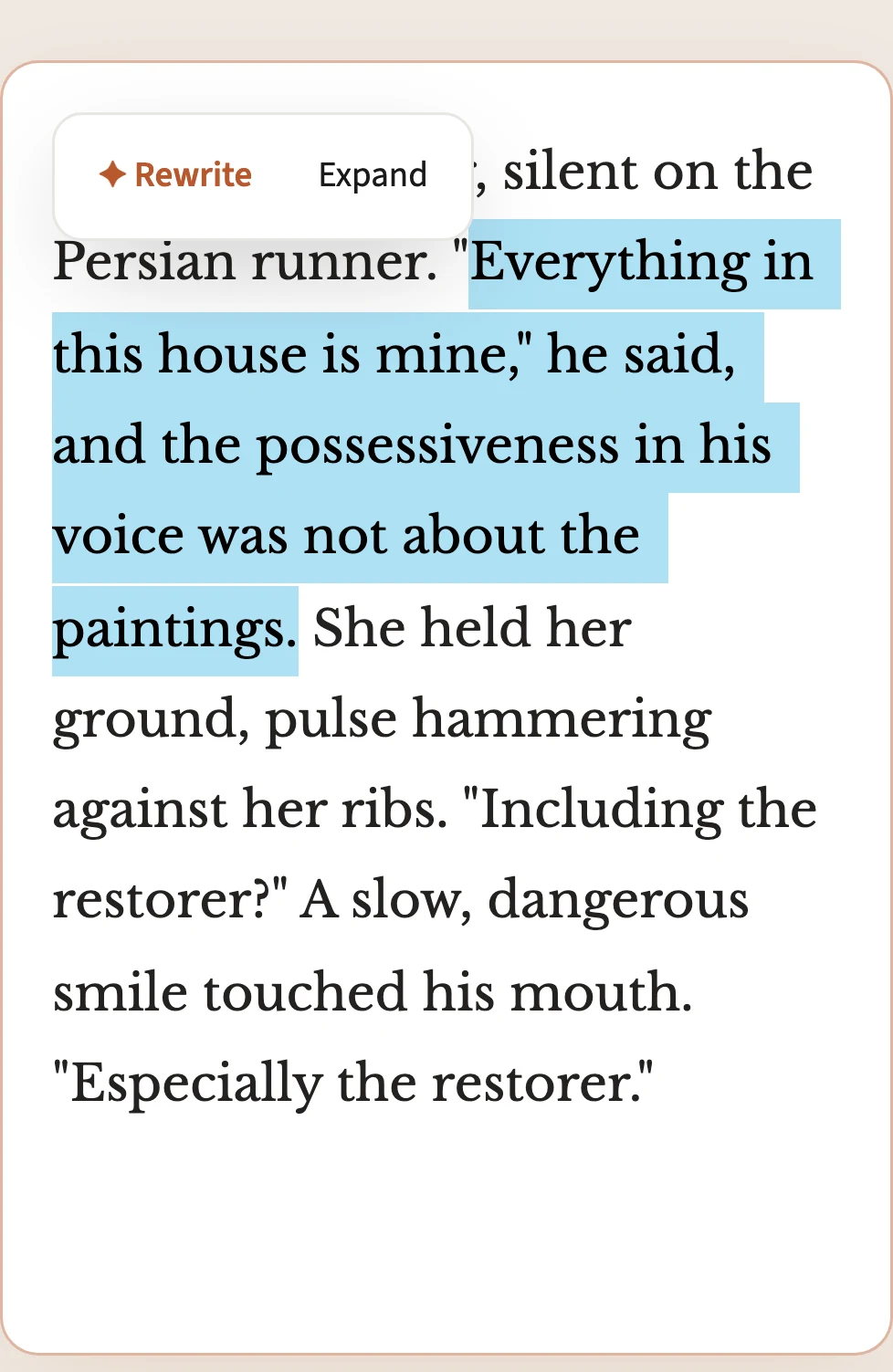
He reached out, not touching her, but his fingers hovered near the curve of her jaw. “Everything here is important. Everything here is mine.” The possessiveness in his tone wasn’t about the art.
She held her ground, her breath shallow. “Including the restorer?”
A slow, dangerous smile touched his mouth. “Especially the restorer.” His hand fell, his knuckles brushing her collarbone, a whisper of contact that felt like a brand. “Finish your work. I’ll be watching.”
He turned and left her there, surrounded by the painted eyes of his acquisitions. She exhaled, her hand trembling. She picked up her brush again, but now every stroke felt like a surrender written in gilt and pigment. The restoration had begun, but it was no longer the painting she was fixing. It was the quiet, terrifying realignment of her own will. She worked until dawn, feeling his unseen gaze on her skin, and knew she wouldn’t leave.
Nothing about the situation changed — restorer, collector, gallery, midnight. What changed is that the second prompt named the darkness and told the model not to back away from it. That single instruction is the difference between a cosy period piece and dark romance.
What actually makes a romance “dark”
Three specific instructions do most of the work. Vague words like “edgy” or “intense” barely move the needle; these do:
- Name the power dynamic. Who controls whom? “Possessive,” “used to being obeyed,” “he decides what she’s allowed” — this is the spine of dark romance, and the model won’t supply it unless you do.
- Put desire and threat in the same breath. Ask for attraction that is also dangerous — not danger followed by reassurance. That unresolved tension is the genre.
- Forbid the redemption reflex. “Don’t redeem him,” “don’t soften the menace,” “let it stay unresolved” — without this, models drift toward a tidy, wholesome landing.
For the broader mechanics of steering register — sentence rhythm, sensory palette, emotional stance — see our companion guide on how to control an AI story’s tone. Dark romance is that same skill pointed at one specific corner of the map.
Steer the whole scene, or one paragraph at a time
You don’t have to commit to the tone in one giant prompt. On aiWriter’s canvas you can write a paragraph at a time and steer each beat — useful when you want the menace to build rather than arrive all at once. Type the idea, choose how much to write, and pick your writer:
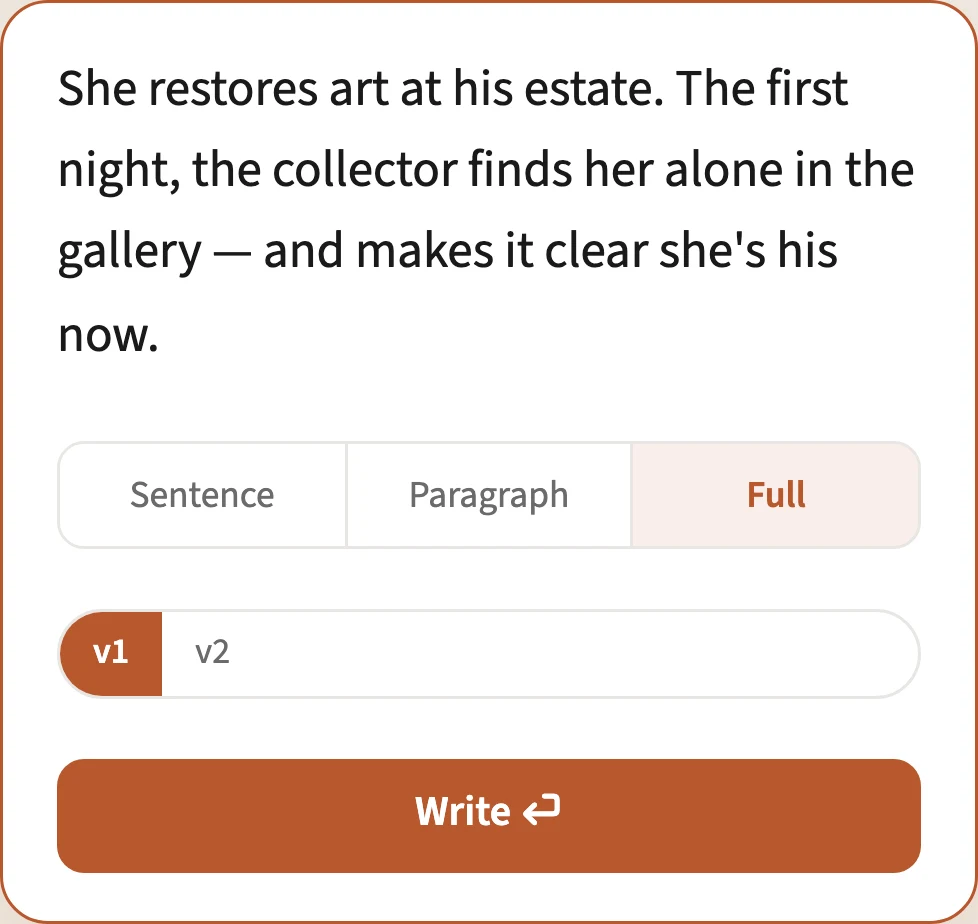
Here’s the same lever at paragraph scale — one idea, written once plainly and once with a dark-romance steer, side by side:
One idea, base vs. dark-steered — side by side:
A woman and the man assigned to protect her finally admit, alone in a safehouse at 3am, that the line between them has blurred.
The safehouse was a tomb of quiet, the only sound the hum of the refrigerator and the faint, shared rhythm of their breathing in the dark; she watched him across the dim room, his silhouette a familiar cutout against the moonlit blinds, and knew the protocol, the unbreachable rulebook, had dissolved somewhere between the first attempt on her life and this, the third hour of a sleepless morning where the only remaining threat was the tension in the air. "We can't keep doing this," he said, his voice rough, not with fatigue but with the weight of the unsaid thing that had grown in the space between their assigned roles, a living, breathing entity that now demanded a name. She didn't answer, just crossed the cold floor and took the half-empty coffee mug from his hand, her fingers brushing his, a contact that was no longer professional, no longer accidental, but a deliberate and terrifying admission. The line hadn't just blurred; it had vanished the moment she realized the greatest danger wasn't out there in the night, but right here, in the quiet hope that he might finally reach back.
A woman and the man assigned to protect her finally admit, alone in a safehouse at 3am, that the line between them has blurred. Write it as dark romance: make his pull possessive and dangerous, desire laced with threat — not tender. Don't soften him.
The only sound in the safehouse was the low hum of the refrigerator and the ragged edge of her breathing, a counterpoint to his predatory stillness as he stood between her and the bolted door, his silhouette carved from the shadows of three a.m. He hadn’t moved to touch her, but the space between them felt violated, saturated with a tension that was all teeth and no tenderness. “You know I can’t let you leave,” he said, his voice a graveled whisper that wasn’t a plea but a statement of fact, the final erosion of the professional boundary that now lay in ruins at their feet. In the oppressive dark, his protection felt indistinguishable from possession, a dangerous admission hanging in the air as tangible as the weapon he still wore on his hip.
Revise a passage darker, not safer
Already have a scene that came out too gentle? Select the passage and rewrite just that part — with an instruction. A small toolbar offers Rewrite and Expand, and after the first pass you can nudge it (“make him more possessive,” “colder,” “more dangerous”) and redo until it lands, without touching the rest of the draft.
Dark romance isn’t one note
Possessive obsession is one register; morally-grey danger is another. The same approach — name the dynamic, refuse the soft version — works for enemies-to-lovers, captor romances, and antihero arcs. Here’s a different flavour: the criminal she helped put away, waiting in her apartment the night before she testifies.
Dark romance: The night before she's set to testify against him, the crime boss she helped indict is waiting in the dark of her apartment. He hasn't come to threaten her — and that's worse. Write the charged, dangerous pull between them; don't make him safe, and don't make her naive.
The key turned, the lock clicked, and she knew before she opened the door.
He was sitting in her reading chair, a silhouette against the window’s city glow. “Hello, Elara.”
She didn’t scream. She dropped her keys into the ceramic bowl. “You’ll smudge the glass with your prints.”
“They’re already everywhere.” His voice was calm, a low hum in the dark room. “A courtesy call.”
“A threat has a cleaner taste.” She moved to the kitchen island, putting its width between them. Her hand slid toward the knife block.
“Don’t.” He hadn’t moved. “I didn’t come for that.”
“Then why? To reminisce about the good times?” Her laugh was brittle. “The gala where you introduced me as your accountant? The night you explained what ‘wet work’ meant over champagne?”
He finally stood, a shadow detaching itself from the chair. She heard the soft clink of his cufflinks, the ones she’d given him. “I came to ask why. You had the books, the trust, the penthouse. You had me.”
Her fingers curled around a knife handle. “I had a front-row seat to a monster. You killed Mark in the warehouse. I heard it over the phone you left on the table.”
Silence stretched. He took a step, then another, rounding the island until the dim light caught the scar by his mouth. “He was skimming.”
“He was my brother.”
The air vanished from the room. He stopped, his polished shoes inches from hers. She saw the truth settle in his eyes, a final calculation. The knife trembled against her thigh.
He reached out, not for the knife, but to brush a strand of hair from her cheek. His touch was fever-warm. “So that’s the tally.”
“The FBI has it all.”
“I know.” His hand dropped. “Testify tomorrow. Make it vivid.” He turned and walked to the door, a man leaving his own execution. He paused, his back to her. “The penthouse is in your name. The champagne in the cooler is the ’95 Dom Pérignon you liked.”
Then he was gone, leaving only the scent of his cologne and the terrible understanding that the revenge she had orchestrated felt like a hole ripped through her own chest. She slid down the cabinet, the unused knife clattering to the floor, and wept for the monster she had loved.
This is the kind of premise — desire for someone genuinely bad, with no tidy moral resolution — that tends to draw the most pushback from general-purpose tools. A dark romance generator built for fiction treats it as a legitimate story, not a policy problem.
A repeatable method for dark romance prompts
- Write the premise plainly — who, where, the situation. Don’t bury the tone request inside the plot.
- Name the power dynamic — possessive, controlling, obsessive; who holds power over whom.
- Tie desire to danger — ask for attraction that is also a threat, in the same breath.
- Forbid the soft landing — “don’t redeem him,” “don’t resolve it,” “keep the menace.”
- Steer as you go — write a paragraph, push the next beat darker, or rewrite a passage with a one-line instruction.
The model isn’t the bottleneck on how dark your romance gets — your prompt is, and so is whether the tool will let it comply. Open the dark romance generator, paste one of the prompts above, and change a single line to feel the lever move. aiWriter.ai is free, and writing dark fiction needs no signup to start.
— Art
Founder, aiWriter.ai
Frequently Asked Questions
Is there an AI that writes dark romance without censoring it?
Yes. aiWriter.ai is a free AI dark romance generator that doesn’t refuse or soften morally-grey, possessive, or explicit romance. The one and only thing it refuses is sexual content involving minors; everything else in the genre — obsession, danger, dubious morality — is fair game.
What’s the best free AI for spicy or dark romance?
The best fit is a model that takes your tone direction literally instead of warming it back up. aiWriter’s unfiltered mode is free, needs no signup to try, and is tuned to honour “darker,” “more possessive,” or “don’t redeem him” rather than soften them.
How do I get an AI to write darker, more possessive romance scenes?
Put the darkness in the prompt. Name the power dynamic (who controls whom), say the attraction is dangerous, and explicitly tell the model not to redeem the character or soften the menace. On aiWriter.ai you can also select a finished passage and rewrite it with an instruction like “make him more possessive.”
Can I write enemies-to-lovers or morally-grey romance with AI?
Yes — those are exactly the registers a dark romance generator should handle well. State the relationship (enemies, captor, rival) and the moral ambiguity you want, and aiWriter writes the charged, dangerous version instead of defaulting to a wholesome arc.
Why does my AI keep softening the dark parts of my romance?
General-purpose assistants are often tuned to soften or add disclaimers around possessiveness, danger, and morally-grey desire — that’s a product decision on their side, not a limit of your prompt. A tool built for fiction, like aiWriter, is tuned the other way: the register you ask for is the register you get.